
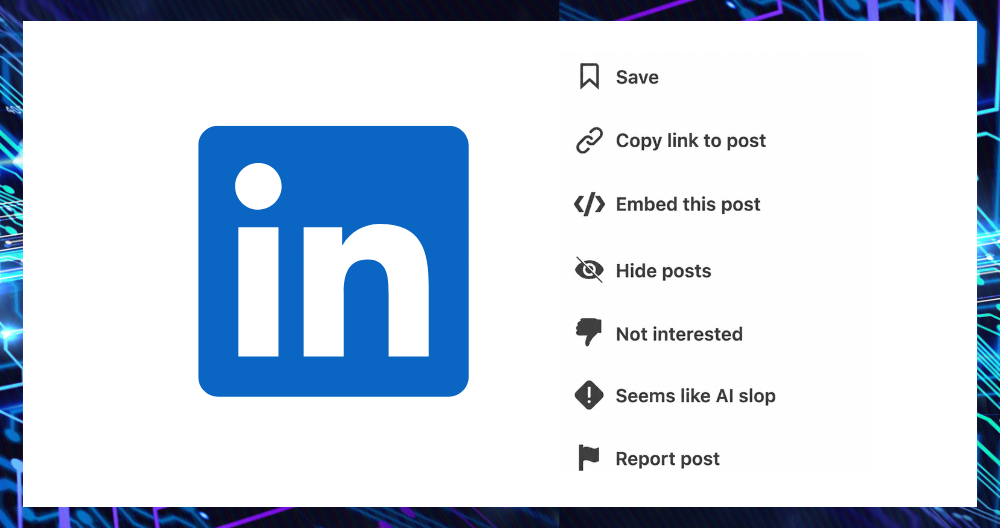
LinkedIn has made several significant changes in 2026, including a new AI-powered feed ranking system, an “AI slop” reporting option and Collaborative Posts.
Together, they point to a broader shift in what LinkedIn wants its professional feed to deliver: content that is relevant, useful and worth people’s time.
For organisations with genuine expertise and limited time, there is a lot to like about that direction.
If your LinkedIn posts have behaved differently this year, you are not necessarily imagining it. LinkedIn continues to make significant changes to the technology behind its feed and the way it identifies content that is relevant to individual users.
For small and medium businesses, government communications teams and not-for-profits, this is a shift worth understanding. Your advantage on LinkedIn was never posting the most. It was having something worth saying.
LinkedIn changes in 2026 at a glance
Algorithm: LinkedIn is rolling out an advanced feed ranking system powered by large language models (LLMs) to better understand content and its relevance to individual users.
AI slop: Users have a feedback option to identify content they believe is low-value AI-generated material.
Collaborative Posts: LinkedIn is rolling out Collaborative Posts globally. Members and Company Pages with access can invite up to five other members or Pages to collaborate on a public post, although the feature may not yet be available to all accounts.
Search: LinkedIn search supports natural, conversational language, making the way people actually describe and ask about topics increasingly important.
How has the LinkedIn algorithm changed in 2026?
In March 2026, LinkedIn announced it was rolling out the next generation of its Feed, using large language models to improve the way content is understood and recommended.
This is more significant than a routine algorithm tweak.
Rather than relying only on traditional signals, LinkedIn’s new system is designed to develop a deeper understanding of what a post is actually about and how it relates to an individual’s professional interests and goals.
In simple terms, LinkedIn is getting better at understanding what you are actually talking about.
The platform also considers how people interact with content over time. LinkedIn says its systems take into account activity including what people read, like, comment on, return to or simply scroll past.
This is important because plenty of people read useful content without ever clicking the like button.
LinkedIn’s new ranking system also considers a person’s engagement history. This helps the platform understand patterns in what someone finds relevant rather than treating every interaction as an isolated event.
The practical takeaway is straightforward. Don’t write for the algorithm. Write something worth someone’s time.
A clear, specific post that answers a real question for your audience, shares useful knowledge or provides an informed perspective has a better reason to exist than content created simply because your schedule says you need to post three times this week.
That doesn’t mean every post needs to be long. It means it needs to be useful.
Read more: Engineering the next generation of LinkedIn’s Feed
LinkedIn has an “AI slop” button
LinkedIn is also confronting one of the less welcome consequences of generative AI: the growing volume of generic, low-value content.
The platform now gives users a deliberately blunt feedback option: “Seems like AI slop.”
The terminology may be colourful, but the underlying issue is important for organisations.
Generative AI has made it extraordinarily easy to produce content. It has not necessarily made it easier to produce content worth reading.
When everyone has access to tools capable of producing a competent LinkedIn post in seconds, simply producing more words is no longer much of an advantage.
None of this is a reason to avoid generative AI. It is a reason to use it well.
AI can be enormously useful for research, generating ideas, structuring information, analysing material, challenging your thinking and improving a draft. It can also help organisations that don’t have large communications teams make better use of their time.
But there is an important distinction between using AI to support expertise and using AI to manufacture expertise.
Your organisation still needs to bring the substance.
That might be something you have learned from delivering a project, an issue your clients keep raising, a change you are seeing in your industry, an informed opinion from your CEO or an insight that comes from doing the work every day.
If ten organisations could have published exactly the same post, it probably isn’t saying enough about yours.
Use AI to help communicate what you know, not to manufacture something to say.
Read more: LinkedIn Help: content feedback and reporting
What are LinkedIn Collaborative Posts?
Another significant 2026 development is the global rollout of Collaborative Posts.
LinkedIn is gradually rolling out Collaborative Posts globally. Members and Company Pages with access can invite up to five other LinkedIn members or Pages as collaborators on a public post. Once an invitation is accepted, the collaborators are displayed on the post and the post appears on their profile or Page. Because the rollout is gradual, the feature may not yet be available to every account.
LinkedIn says the feature provides a way to share insights and successful results together, while potentially reaching new audiences.
It creates some interesting possibilities for organisations.
A not-for-profit could co-author a post with a corporate sponsor about a program they have delivered together.
A business could publish a client success story with the client participating in the post rather than simply being tagged in it.
An industry association could collaborate with speakers following an event.
A government team could publish with an organisation delivering a program in the community.
It is a subtle difference, but an important one. Instead of one organisation talking about a partnership and tagging the other party, both can be visibly associated with telling the story.
Instagram has demonstrated how useful the collaborative model can be for bringing different audiences together around one piece of content. LinkedIn is now applying a similar idea to a professional environment where partnerships and organisational relationships can carry considerable credibility.
The bigger opportunity is to start thinking differently about the stories you already have.
If you are working with clients, community partners, sponsors, industry bodies or other organisations, there may be stories that are stronger when you tell them together.
Read more: LinkedIn introduces Collaborative Posts
LinkedIn search is becoming more conversational
There is another development worth paying attention to, particularly as search behaviour changes more broadly.
LinkedIn search now supports natural, conversational language as well as keywords. People can describe what they are looking for in ordinary language rather than relying solely on exact keyword matches.
LinkedIn says its search is designed to interpret the intent behind a query, including full questions.
For organisations, this reinforces something we are seeing across digital communications more broadly: the language real people use to describe your work matters.
Think about the questions clients, customers and stakeholders actually ask.
What does your organisation do? Who do you help? How does your service work? What problem do you solve? What do people need to know before working with you?
Those questions can inform your LinkedIn profile and Company Page, but they can also provide a useful source of content ideas.
Instead of asking “What should we post this week?”, start with “What are people asking us?”
That is likely to produce better content regardless of what the algorithm does next.
Read more: Search on LinkedIn
What should organisations do now?
Write fewer, better posts. Aim for content your audience will genuinely read, find useful and remember, rather than producing content simply to maintain volume.
Keep your voice human. Use generative AI to research, organise, question and refine your thinking, but make sure the final content reflects the knowledge, experience and personality of your organisation.
Look for genuine collaborations. Consider clients, sponsors, partners and stakeholders where you have a worthwhile story to tell together. Collaborative Posts provide a new way to make those relationships visible.
Answer real questions. Think about what your clients and stakeholders actually want to know and use their language when you talk about it.
LinkedIn’s latest changes don’t mean organisations need another complicated social media strategy.
If anything, they bring us back to some very traditional communications principles.
Know your audience. Understand what matters to them. Have something useful to say. And say it in a way that sounds like you.
The technology around those principles may be changing rapidly, but the principles themselves haven’t changed very much at all.
If you would like to talk through what these changes mean for your organisation’s communications, we are always happy to help.
Infodec Communications helps small businesses, government teams and not-for-profits with strategic communications, grant and tender writing and public relations.