

The Digital News Report: Australia 2026, released by the University of Canberra’s News and Media Research Centre, is the most comprehensive annual snapshot of how Australians find, consume and trust news. For anyone responsible for getting a message in front of an audience, whether you run a business, lead a not-for-profit or manage communications for a government body, this year’s findings should prompt a hard look at your strategy.
Here is what stands out, and what it means for you.
The audience has scattered
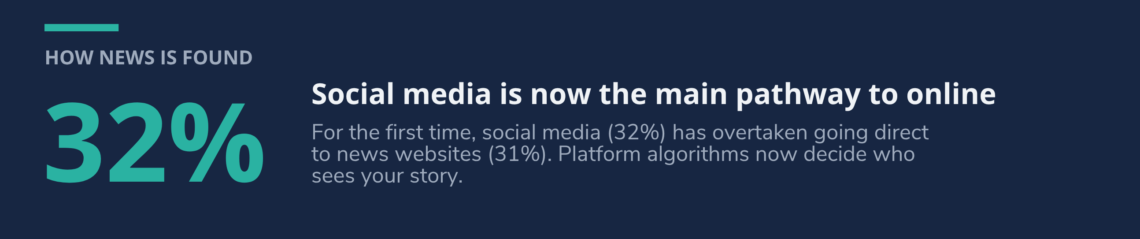
Social media is now the second most used news source in Australia at 56 per cent, sitting just behind television at 57 per cent. More significantly, social media has overtaken direct visits to news websites as the main pathway to online news for the first time. One third of Australians now access seven or more news brands every week.
The practical upshot: there is no longer a single channel, or even a shortlist of channels, that reliably reaches your audience. A media release picked up by one masthead, or a story on the evening news, no longer does the job it did a decade ago. Visibility is increasingly decided by platform algorithms, not editors.
Influencers are an increasingly important part of the news ecosystem
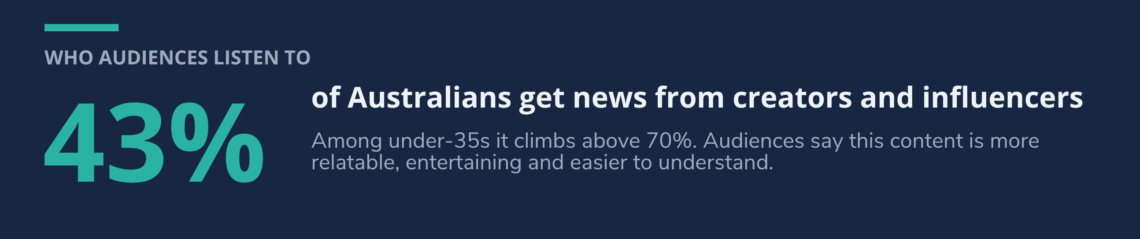
This is the finding communications professionals cannot afford to dismiss. Forty-three per cent of Australian news consumers now get news from individual creators and influencers. Among people under 35, that figure climbs to more than 70 per cent, and around half of that cohort say influencers meet all or most of their news needs.
Why? Audiences describe influencer content as more entertaining, more relatable and easier to understand than mainstream news. They are not seeking spin. The report is clear that what audiences want is authenticity: a clear viewpoint, complex stories broken down, and delivery that feels like a trusted friend explaining something rather than a formal broadcast.
For clients, this opens a genuine opportunity. Partnering with credible creators in your sector, or building your own spokespeople into relatable, plain-speaking voices, can reach audiences a traditional media pitch never will. The caution is quality. The influencer market is highly fragmented, standards vary wildly, and a poorly chosen partnership can damage trust rather than build it.
Trust is the whole game
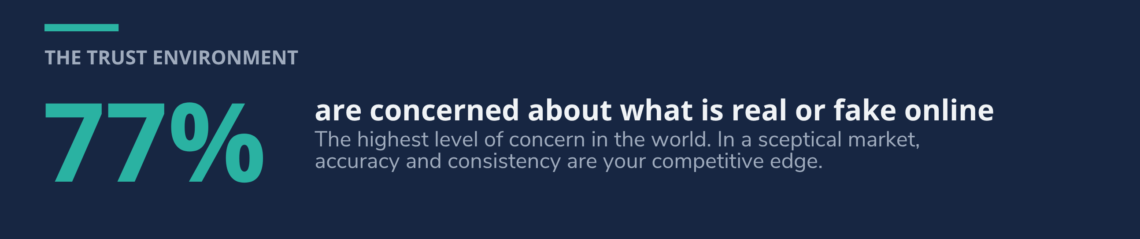
Overall trust in news sits at just 43 per cent, and 77 per cent of Australians are concerned about what is real or fake online, the highest level of concern in the world. Trust in news on social media (21 per cent) and from AI chatbots (19 per cent) is lower still.
This is a threat and an opportunity in equal measure. The threat: your message enters an environment where audiences are sceptical by default, and two thirds of Australians actively avoid news at least some of the time. The opportunity: the report found that perceived quality is one of the strongest predictors of trust, and trust drives engagement. Organisations that communicate accurately, consistently and without overclaiming stand out precisely because so much around them does not.
For not-for-profits and government bodies in particular, this is encouraging. Half of Australians believe public service media play a positive role, and audiences reward institutions seen to deliver reliable information. Credibility, built patiently, is now a competitive asset.
AI is quietly reshaping discovery
Nearly one in ten Australians already use AI chatbots such as ChatGPT to get news, and users click through to original sources far less often than they do from search engines. People use these tools to summarise, collate and verify.
The strategic question for every organisation: when someone asks an AI tool about your sector, your cause or your organisation, what does it say? Being findable and accurately represented in AI-generated answers is fast becoming as important as traditional search visibility. That means well-structured, factual, authoritative content on your own channels, because that is what these tools draw on. The good news is that there are strategies to address this issue.
What this means for your strategy
Three shifts worth making now:
Diversify beyond the media release. Earned media still matters, but it should sit inside a mix that includes short-form video, owned channels, direct formats such as newsletters, and where appropriate, creator partnerships. The report found 73 per cent of Australians now watch news video online weekly, most of it under two minutes. If your organisation is not producing short, plain-spoken video, you are invisible to a growing share of your audience.
Communicate like a person, not an institution. The formats winning attention are conversational, personal and purposeful. This means it is important to translate expertise into language and formats people actually choose to engage with.
Invest in trust as infrastructure. Accuracy, transparency and consistency are no longer required factors. In a low-trust environment, they are the differentiator, and they compound over time.
The organisations that will thrive in this environment are those that stop asking “how do we get coverage?” and start asking “how do we become a source people trust, wherever they find us?”
Source: Park, S. et al. (2026). Digital News Report: Australia 2026. News and Media Research Centre, University of Canberra. The full report is available at the News and Media Research Centre website.